jmtd → computing → Network Attached Storage (NAS)

Coolermaster case on the right
Φόβος (phobos) is the name of my NAS, backup and home server. The current hardware setup is described at phobos; this page aims to describe the rationale, setup, software and usage, mostly of backup.
Software
Debian GNU/Linux for the operating system.
I don't use RAID (which is not backup).
Remote decryption
I use full-disk encryption which necessitates supplying a passphrase when the
machine is booted. Since this is a headless box, some additional work is needed
to permit supplying this passphrase over the network. Luckily most of the work
is done already by installing the dropbear-initramfs Debian package and reconfiguring
keys and authorized_keys files in /etc/initramfs-tools afterwards. This means
I can SSH into the pre-boot environment. From there, I just need to run
cryptroot-unlock and supply the decryption passphrase.
Notifications
LED
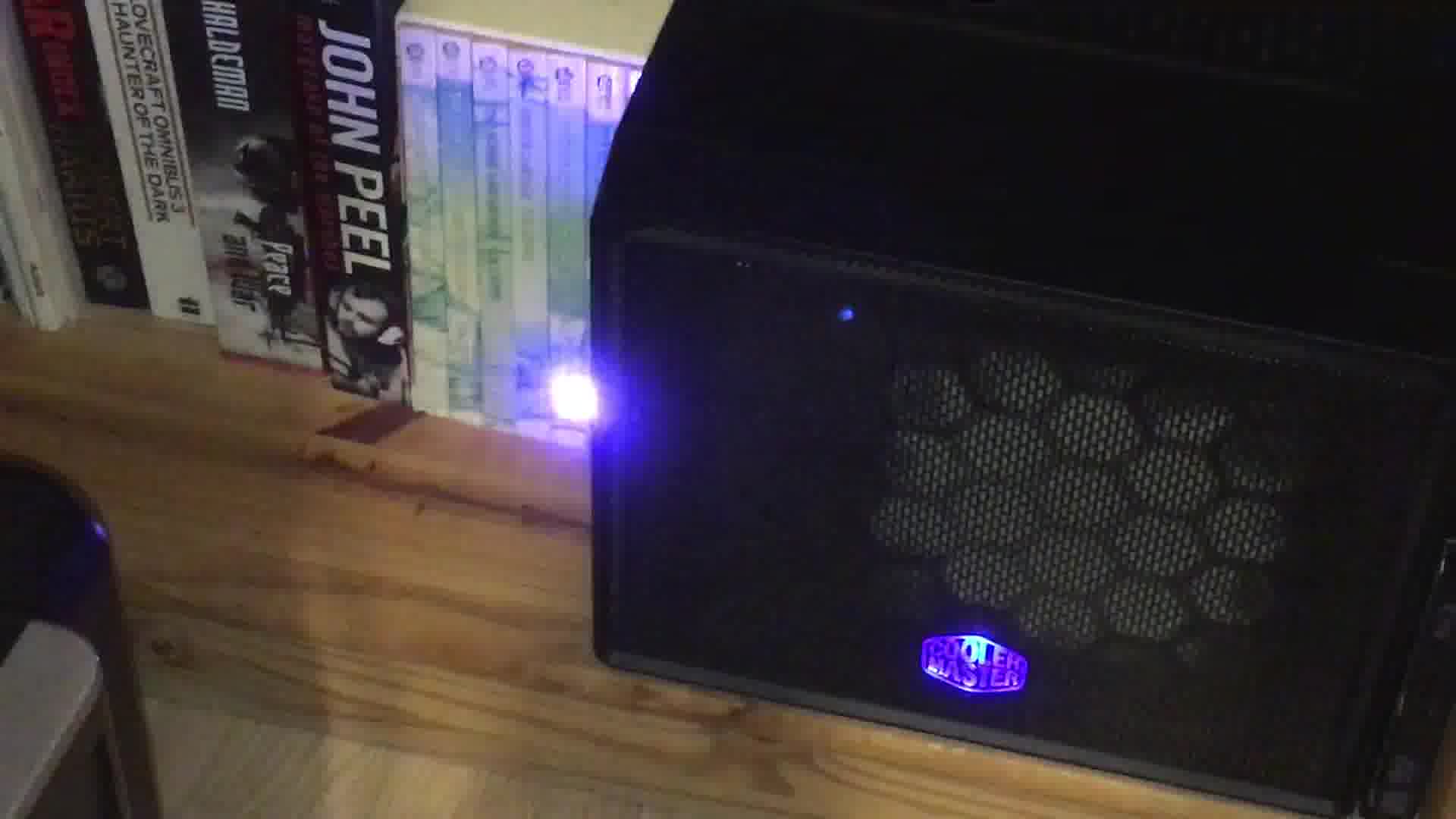
blinkenlights!
I wanted to add a means of notifying me of events on the machine. I bought a
Blinkstick Nano, a tiny USB stick with an LED on each
side. I've hooked calls to change the light colour into the success/failure paths
for the systemd jobs that drive my backups. Further details here:
1,
2,
3.
The light defaults to off. When an interactive job is in progress, it turns on and blue. When the job completes, the light changes to either green or red depending on success or failure. Green means I am safe to remove the drive, in the case of external drives.
When a non-interactive, scheduled job fails, the light turns red. I usually notice this next morning.
Following some instructions on the Arch
wiki, I
configured Systemd to mail me if a job fails. A generator service is referenced
via OnFailure=status-email-user@%n.service. The generator:
[Unit]
Description=status email for %I

[Service]
Type=oneshot
ExecStart=-/usr/local/bin/systemd-email %i
ExecStart=/usr/local/bin/blinkstick --index 1 --limit 50 --set-color red
Group=systemd-journal
DynamicUser=yes
where /usr/local/bin/systemd-email is simply
systemctl status --full "$1" | mail -s "unit $1 failed" root
Backup software
I backup remote hosts to locations on the NAS via rsync.
I backup local files (including the backups of remote hosts) using Borg (v1.4).
Each month I backup the local Borg repository alternately to one of
a pair of external drives (again using rsync) which are kept out
of my house.
setting up borg repo
borg init --encryption=none --umask 0007 /backup/testborg
chgrp -R jon testborg
chmod g+s testborg testborg/data testborg/data/0
borg create --stats --umask 0007 /backup/testborg::TestLocal /etc/apache2
with client/server in the mix, the server could be non-root and the repo entirely non-root, only the client needs to be root to read files to send to client...
Remote hosts
Borg works using a push model: a backup client needs to have permission to
connect to the Borg backup server, and self-initiates its backups. I prefer
to pull from my backup server, and have the clients trust it — less chance
that an external host is compromised giving an attacker access to my NAS. The
schemes for achieving this in Borg (ssh tunnels) are awkward, so instead I do
things in two phases: a simple server-initiated rsync of clients to a holding
space in the NAS, followed by local-only Borg backups of the holding spaces.
TODO: At the moment, nothing except scheduling prevents the rsync jobs from
running at the same time as the borg ones. I should add the necessary
exclusions (After=, I think)
Borg / Borgmatic
The main backups are via Borg, but I use borgmatic as a convenience wrapper
and that's what I schedule (via systemd timer) to fire at 3am nightly. The
script calls borgmatic --prune --create, which has several different
backups configured (currently 9). These run serially.
I deliberately omit --check from borgmatic or it would run a borg check
for each of these nine configurations. Instead I run borg check separately,
currently scheduled once a week.
It typically takes 1h15m for the backups to run and 5h30m for the check stage to run.
backup mount namespace
To protect against an accidental (or malicious) process corrupting the backup filesystem, I want to limit access to them to only the processes that need to access them.
My first stab at solving this was mount on demand backups. This reduced the risk to the time that the backup jobs were running, but didn't eliminate it.
I've since moved to creating a persistent mount namespace for the purpose. For now the best description of this is at mount namespaces.
Third-strand external
Every month I backup the Borg backup repository to one of two external hard drives that live off-site the rest of the time. This requires an exclusive lock for the Borg database so I cannot do it if the Borg backups or check jobs are running.
To ensure this, I invoke rsync via borg with-lock: this ensures
the repository is locked and if another borg job is started during the
sync, it will either wait or fail.
In recent times this has taken anything between 2h20m and 5h.
preparing the drive
This is mostly just a standard dm-crypt/cryptsetup/LUKS encrypted device, with a normal filesystem sitting on top: Basically, the most common way to encrypt a drive in Linux. See places like the cryptsetup docs for how to set something like that up. The key things here are
Place a LUKS encrypted device on top of the drive, and a filesystem on top of the encrypted device with the label "extbackup". The convenience script
luksformatcan be used to one-shot this:luksformat -t ext4 -L extbackupAt this stage I use a password as the decryption method.
set up a decryption key file so the device can be decrypted unattended. Store that somewhere on the filesystem of the NAS and add it as a decryption key to the device using
cryptsetup luksAddKey <device> <keyfile>back up the LUKS header:
luksHeaderBackup <device> --header-backup-file <file>make a note of the crypt device's UUID: it's needed for the
WantedByline in the backup service file. (look at which symlink in/dev/disk/by-uuidpoints at the correct partition device)set up a
/etc/crypttabline with all the info needed to decrypt. Mark itnoauto. Example:dummybackup UUID=b0281a09-c807-42a3-8e48-17ee982c9854 /root/exthdd.key luks,noauto
no need to:
set up a /etc/fstab line with all the info needed to mount, keying
off the label, but mark it noauto
How
As much as possible I lean on systemd and its ability to trigger actions
based on events. Here's what happens when one of my external backup drives
is plugged in:
systemdinstantiates a corresponding device unit, nameddev-disk-by\x2duuid-$UUID.device, where$UUIDis the UUID of the device, with the dashes substituted for\x2d, as systemd requires.
?2. The backup job is a systemd service which has a WantedBy relationship
on the device unit, so when the device appears, systemd starts the
backup service.
The backup service has
RequiresandAfterrelationships onsystemd-cryptsetup@extbackup.service, a service originally created bysystemd's cryptsetup generator, but I altered it to addStopWhenUnneeded=true1. The encrypted device is therefore unlocked (but not mounted)The backup service looks has
ExecStartPre=/home/jon/bin/mkbackupns, which creates (if necessary) the backup mount namespace.The backup service then executes the main backup script (described in the next section), wrapped in
/usr/bin/nsenterrun inside the backup mount namespace.
Once the backup script has finished:
systemd deactivates the
backup-exthdd.service,and, since it is not wanted by an active service it also stops the
systemd-cryptsetupservice, locking the device.
The backup script
The backup script itself is not complex:
#!/bin/bash
set -euo pipefail

echo starting phobos-backup-monthly "($*)"
blinkstick --index 1 --limit 10 --set-color yellow # 'working'

mount /extbackup

borg with-lock /backup/borg rsync -a --delete \
    --max-alloc=4GiB \
    /backup/ /extbackup/

umount /extbackup

echo phobos-backup-monthly "($*)" finished
blinkstick --index 1 --limit 10 --set-color green
In stages:
- set the blinkstick to the working colour (yellow)
- mounts the filesystem from the external drive. (I can't rely on
systemd's
.mountservice type to do this.) - call
rsyncto sync the internal backups to the external... - ...wrapped in
borg with-lockto ensure we are mutually exclusive with anyborgjobs. - unmounts the filesystem
sets the blinkstick to the success colour (green)
I notice the LED colour is green, remove the drive, and take it to its off-site home.
If anything goes wrong, all my custom systemd units have,
as a matter of course,
OnFailure=status-email-user@%n.service blinkstick-fail.service
Schedule
I keep forgetting when the backup jobs typically are running (which excludes doing other things at the same time), so here's a rough sketch.
| Time | Borg | Rsync | External (example) | |
|---|---|---|---|---|
| 0000 | ||||
| 0100 | ||||
| 0200 | ||||
| 0300 | borgmatic backups starts | |||
| 0400 | backups… | |||
| 0415 | borgmatic backups finishes | |||
| 0500 | ||||
| 0600 | backup-luv starts & finishes | |||
| 0700 | weekly borg check starts | |||
| 0800 | check… | |||
| 0900 | check… | |||
| 1000 | check… | |||
| 1100 | check… | |||
| 1200 | weekly borg check finishes | |||
| 1300 | ||||
| 1400 | ||||
| 1500 | sync-nuhc starts & finishes | |||
| 1600 | ||||
| 1700 | ||||
| 1800 | ext starts | |||
| 1900 | running… | |||
| 2000 | backup-chew starts & finishes | running… | ||
| 2100 | running… | |||
| 2200 | running… | |||
| 2300 | ext finishes | |||
Footnotes
-
I customized mine a while ago by copying the generated service file to a
static file, but nowadays I think you could do
systemd edit
   systemd-cryptsetup@extbackup.service
to add theStopWhenUnneededto an override file and not need the rest.↩