jmtd → Jonathan Dowland's Weblog
Below are the five most recent posts in my weblog.
- Bauer X4 inline skates, posted on
- DIY skate punch-out, posted on
- time-delayed scifi roundup feed, posted on
- Interzone digital, posted on
- Bauer Fly30 ice skates, posted on
You can also see a reverse-chronological list of all posts, dating back to 1999.
I’m really enjoying getting back into ice skating, but I can only get to the rink once a week (at least over the summer -- I'm aiming for twice weekly once Schools re-open) and I have the itch to do more skating than that.
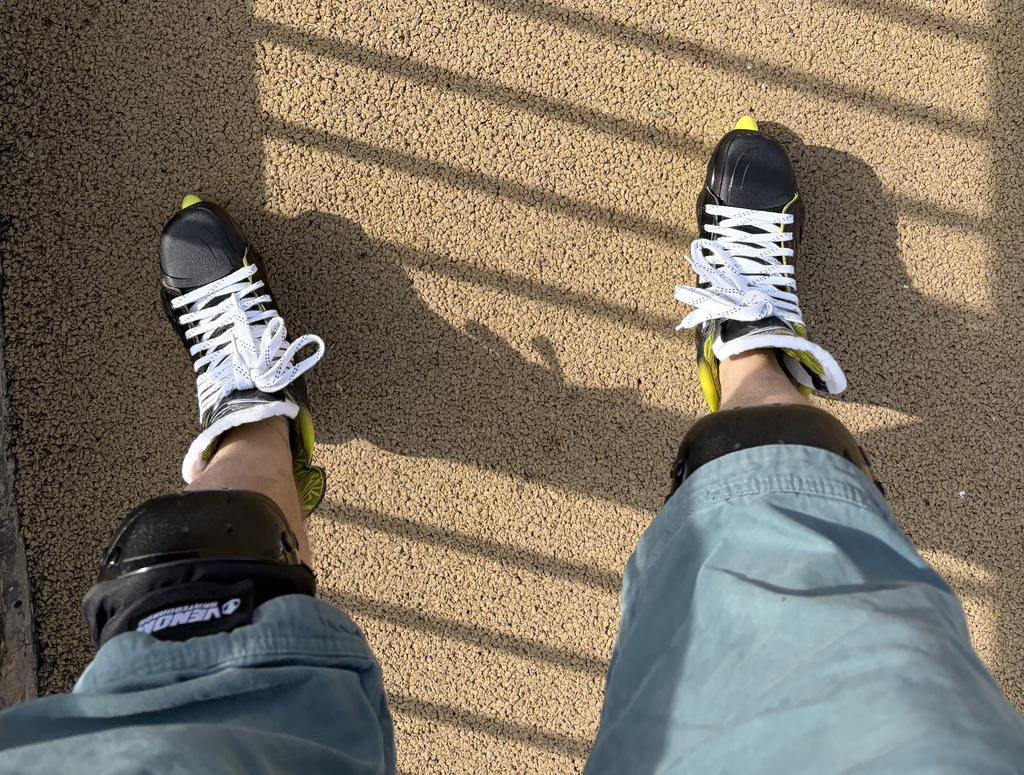
Where I live we’re blessed with a seaside park with lots of smooth paths, a recently resurfaced beachside promenade, and a newly-built pedestrian/cycle path stretching up and down the coast: all great surfaces for roller skates. I convinced myself to buy some inline skates whilst the weather is good.
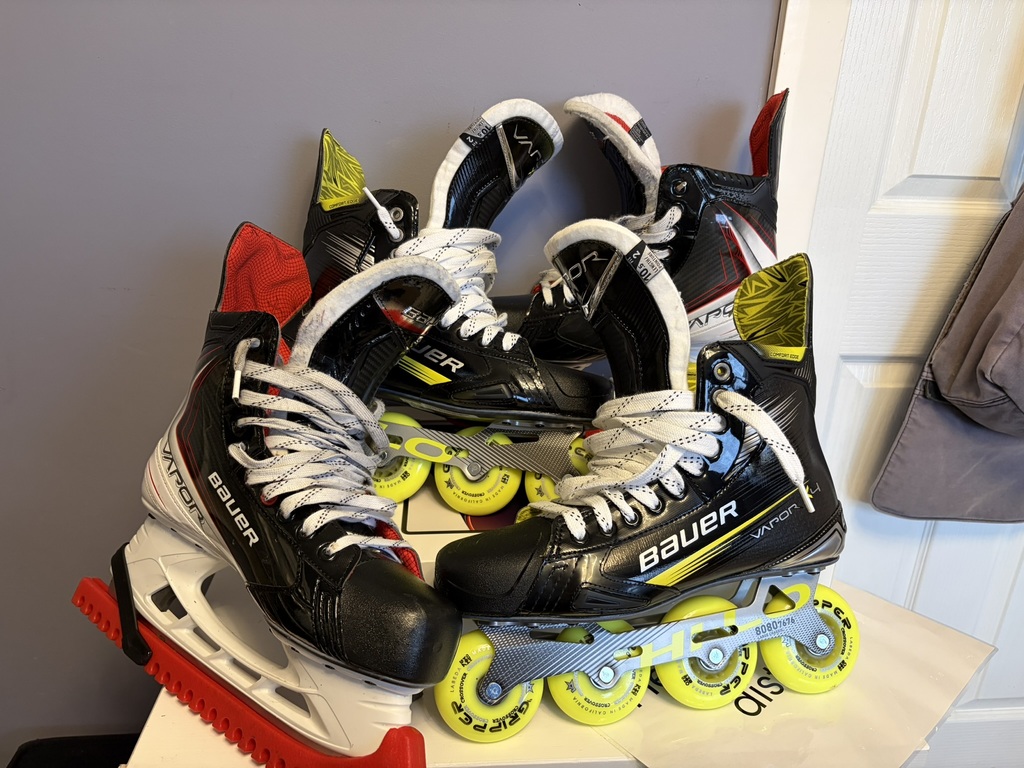
I wanted something as close to my ice skating experience as possible. Bauer actually make an inline version of my ice boot, but the chassis is an unusual composite plastic thing which put me off. (here's a great video of a fantastic inline skater trying out the chassis). CCM have a new inline range for 2026, but sadly (much like their Jetspeed ice range) the fit wasn't good for me.
I found a clearance pair of Bauer vapors from the previous generation: the Bauer Vapor x4. Very similar to my Fly30, but the difference in quality between the tiers is very apparent: boot stiffness, the comfort and quality of the liner. They fit well (possibly better), the rolling motion is really smooth (I think that's the bearings) and they looked pretty good to me: yellow highlights instead of the red used across the ice range.
I've done a couple of miles in them so far. Time will tell if they prove useful for off-ice training! Many inline hockey players buy ice skates and convert them to inline. If I end up not using them enough I could consider doing the opposite.
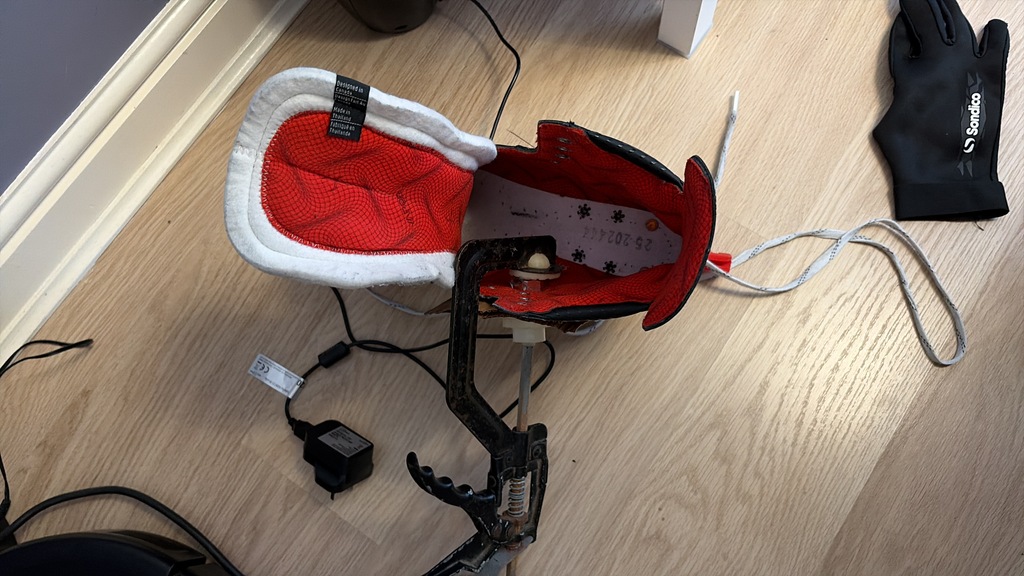
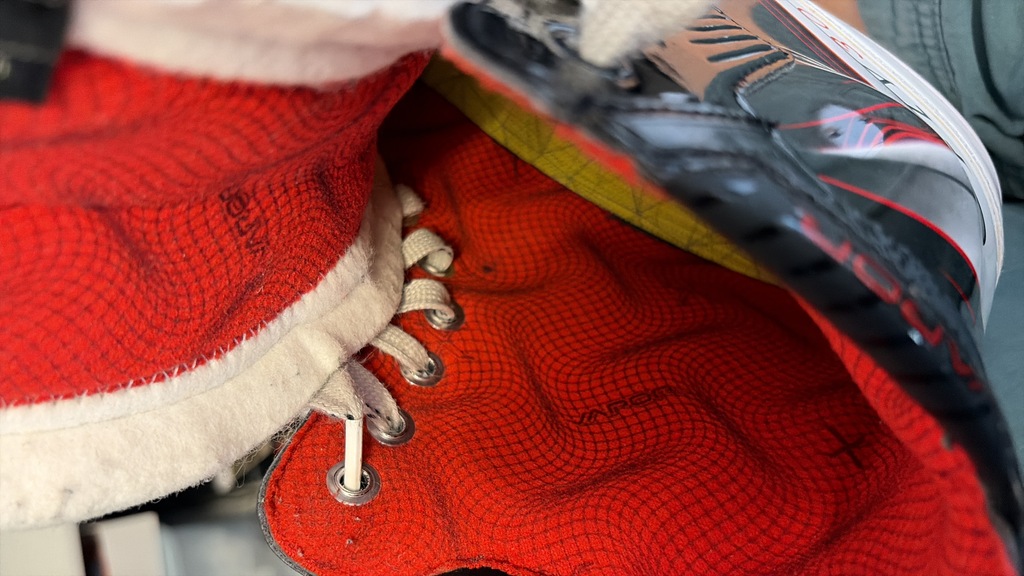
Since I wrote about my fly30 ice skates, I'd continued to battle pain around the navicular bone in my feet. The action that seems to have finally fixed it was to perform a "punch out": a very localized remoulding of the area of the boot that presses against the sore area.
I basically followed the process from this helpful YouTube video.
I narrowed down the exact spot by borrowing some lipstick and transferring it from my navicular bone to the boot lining, then making that more permanent with a sharpie.
My punch was a spare part from a radiator valve which I packed with US cents (I couldn't fit any UK coins in). For the receiving-end, I tried another part from the radiator valve but I think it wasn't sufficiently larger than the punch to work well, so I swapped that out for a spoon.
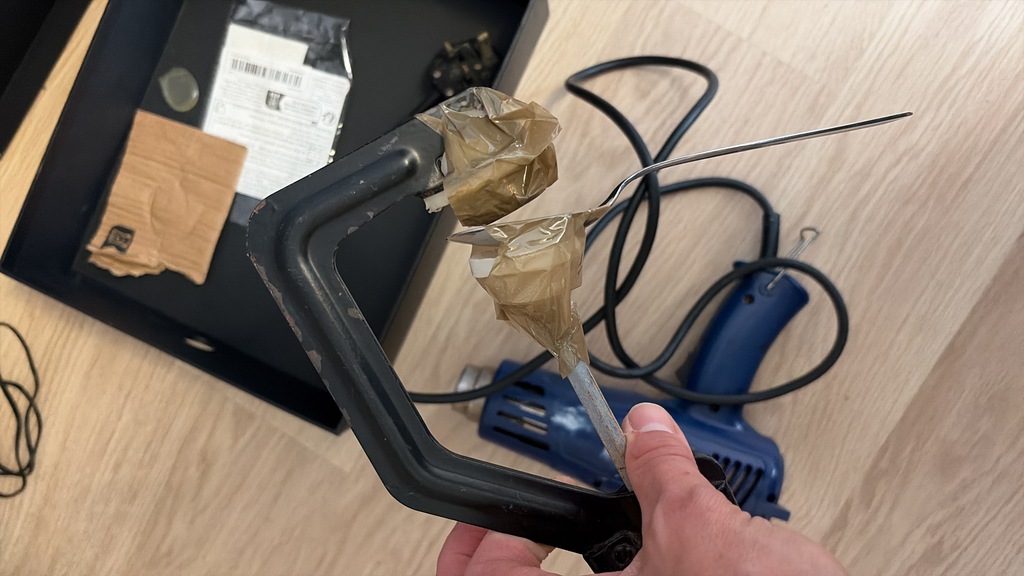
take 2
I didn't have a temperature sensor I could use and I used a heat gun rather than a hairdryer, so I YOLO'd it a little. Some of the wrap on one of my boots is now distorted from where I didn't move the heat gun enough. It only took a minute or two to get the boot hot enough to be flexible. I set a 15 minute timer once the clamp was in place.
I've only skated one session since I did this but the pain seems to have gone! It's remarkably freeing to be skating without constantly trying to manage pain. Now I can focus on technique.
I enjoy reading The Guardian's monthly round-up of new SF novels, which can be found in their Science Fiction Books section, and can also be read via feed. Since the round-up is of new books, at the time the round-up is published they're usually only available in hardback.
When it comes to choosing a book to read, these days I am tending towards paperbacks: I've largely ran out of room for hardbacks. So I decided to apply a time delay to their feed. Six months is roughly enough that a book mentioned in a round-up should be shortly available in paperback.
The first obstacle was that The Guardian only publish roughly the last six months of articles in their feed, and so the posts I want have disappeared. However, my Feed Reader (FreshRSS) had older copies stored in its database, and I am able to re-publish those using User Queries. (This also gives me an opportunity to filter out non-roundup articles from the Guardian's feed).
It's then a nice short piece of scripting (this time, using Ruby) to filter the republished feed on the publication date. To make the most recent articles appear new, I also modify the metadata for filtered entries to appear 6 months newer than they are.
#!/usr/bin/ruby
require 'rss'

# replace with the user query feed URI
uri       = 'https://www.theguardian.com/books/science-fiction/rss'
now       = Time.now
sixMonths = 6 * 30 * 24 * 60 * 60
feed      = RSS::Parser.parse(uri)

feed.items.select! do |item|
  item.date + sixMonths < now
end
feed.items.collect! do |item|
  item.date += sixMonths
  item
end

puts "Content-Type: text/xml\r\n\r"
puts feed
I stuck that up on my private web server, subscribed to it in my FreshRSS and voila, a time-delayed list of books to read, most likely available in paperback.
(no, this isn't a blog post about Joy Division songs)
Last time I wrote about Interzone, I was discussing issue #294, the first published under new management in a paperback-sized format ("JB6"). The format and presentation of the magazine was fantastic: it fit in a lot of my pockets, and was packed with 15 stories as well as the regular columns, in full colour with fantastic layouts and illustrations. Sadly there was only one more physical issue before Interzone was forced to become a digital-only publication.
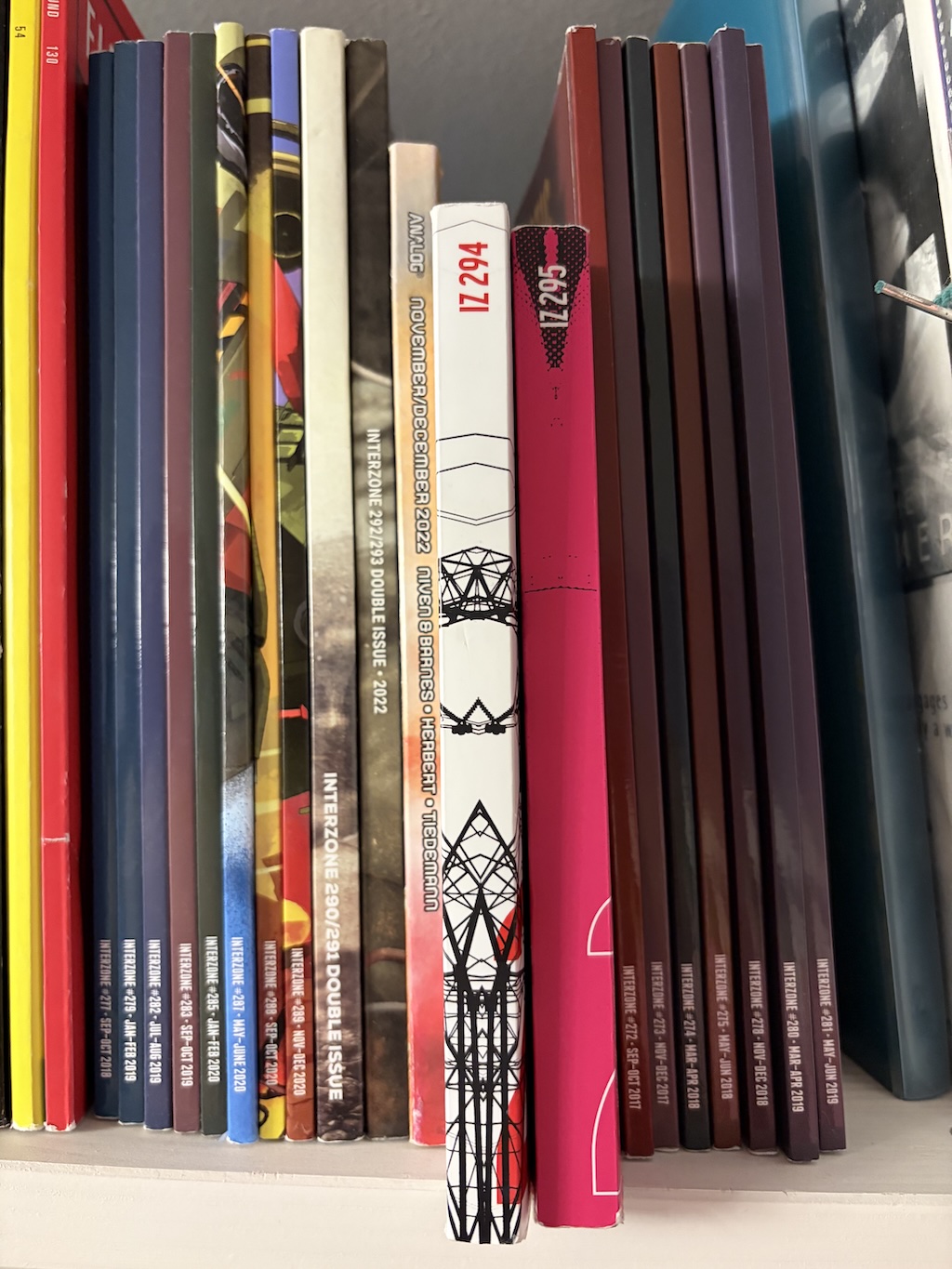
IZ issues 294 and 295
I don't want to dwell on the sad necessity to move to digital. Interzone continues on, celebrating the milestone issue #300 in 2024. Subscriptions are managed via Patreon. Issue #305 just came out.
Instead I wanted to write a small bit about how I engaged with the paper magazine, and the difficulties I've had trying to engage with not just Interzone but any magazine-style publication in a digital context.
With most fiction, I read linearly: start the beginning and read to the end, in order. That works well for me with e-readers. But for magazines (and most non-fiction) I don't, I jump around: usually starting with the table of contents, I might pick a short column to start, or jump into the middle of the "book reviews" section to read about a specific book. I might skip sections entirely. I find it very difficult to read like this with an e-reader. I think this is partly because I reference the depth of the paper book or magazine, its thickness, to orient myself. But it's also partly the limitations of e-ink.
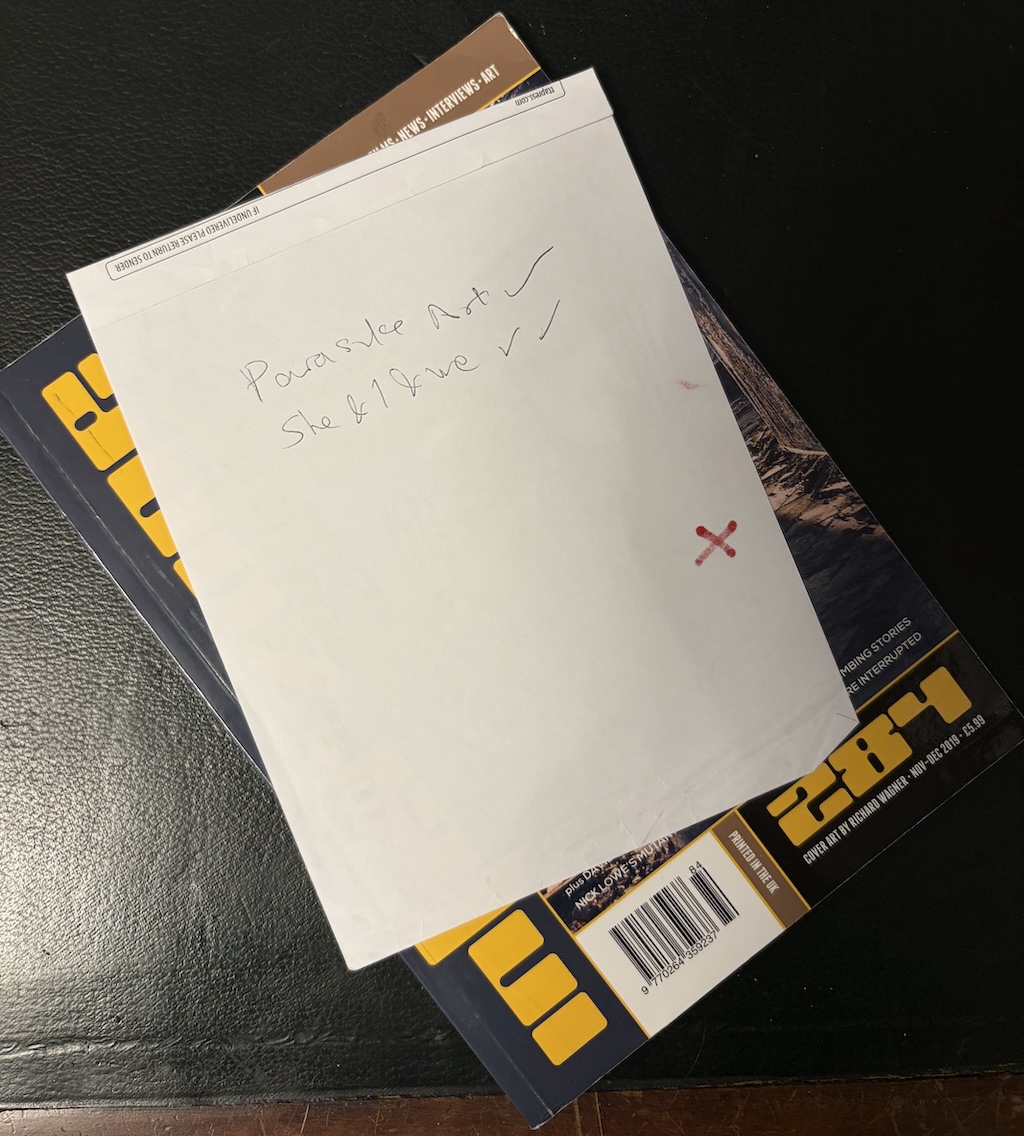
My tick-list for an issue of IZ
For print-Interzone, I used to start by inserting a small piece of paper inside the cover (the delivery slip was ideal). On this I listed the stories within and ticked them off when I read them (sometimes I double-ticked if I really liked a story). That helped me to remember, perhaps months or years later, whether I'd read all the stories or not, and which I liked. I could do something similar on some e-readers: the Remarkable for instance. But it's far from convenient to do on most e-ink devices.
Interzone digital is available as both ePUB, the most common format for e-books, and PDF. For reading on my regular Kobo e-reader, PDFs don't work very well at all. I think this is generally true of most e-readers.
Interzone was (and is) a well-designed magazine. The value of it was not just the content of the text, but the context: how the stories were presented; the accompanying art (most often colour in recent decades), but also the typesetting. ePUB doesn't specify much of that stuff exactly: it leaves that up to the client and the client's preferences. And there's a lot of advantages to that: Prefer a different font face or size? No problem. And most importantly for accessibility: If reading in ePUB makes Interzone available to more readers then that's a great thing. But sadly a lot is lost, IMHO.
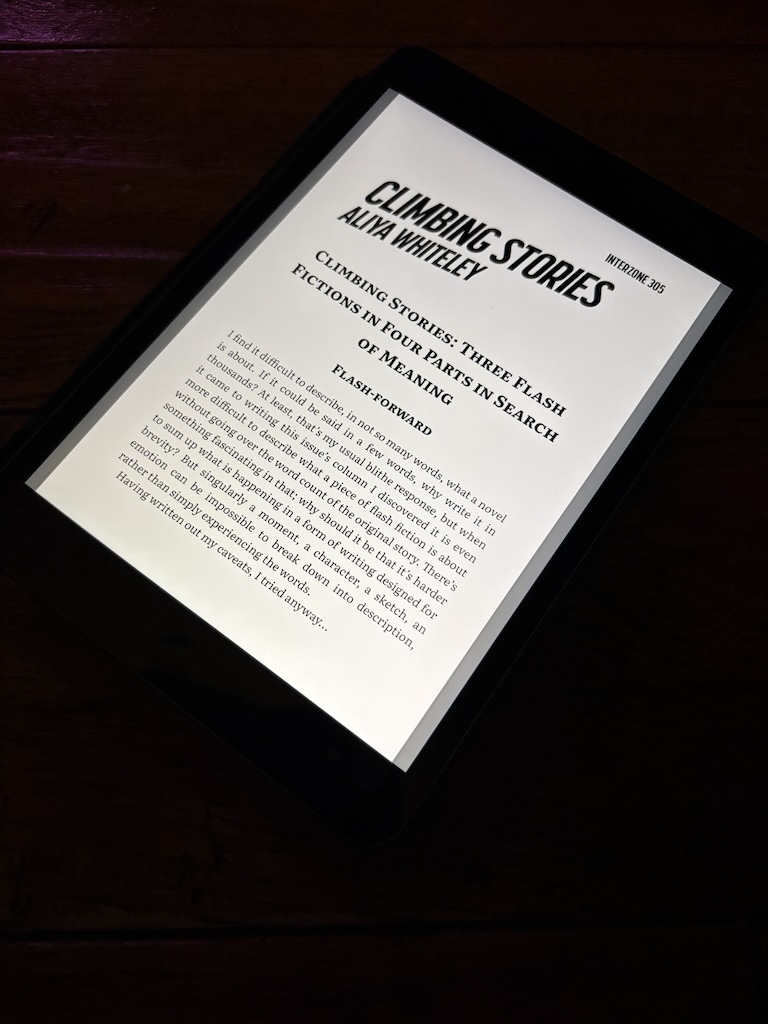
IZ #305 on iPad Mini
The solution I'm trying is to read the PDF version on the iPad Mini I resurrected earlier in the year. Despite being an Internet tablet, since it's not really usable for browsing the web anymore it's strangely still a distraction-free device. In fact it's pretty much single-purpose for reading Interzone and the odd other book which benefits from being read as PDF. I can appreciate the stylistic choices made in the page-setting as they were intended; I can quickly jump around the issue without waiting for an e-ink refresh; I get full colour; and whilst it would be tiring to read for a long time on the iPad screen, for the length of articles or stories in a magazine, this isn't a problem.
It's not a solution for tracking what I've read (that version of ipadOS is too old to support clumsily scrawling on PDF pages with your fingers, at least in the Books app) but it otherwise seems to work well, so I'll see how it goes.
I used to ice skate as a teenager but I stopped at University. I tried to pick it back up in 2024 but had to stop when I got ill. I restarted in 2025, initially with a weekly skate session but last month I started group hockey skate lessons.
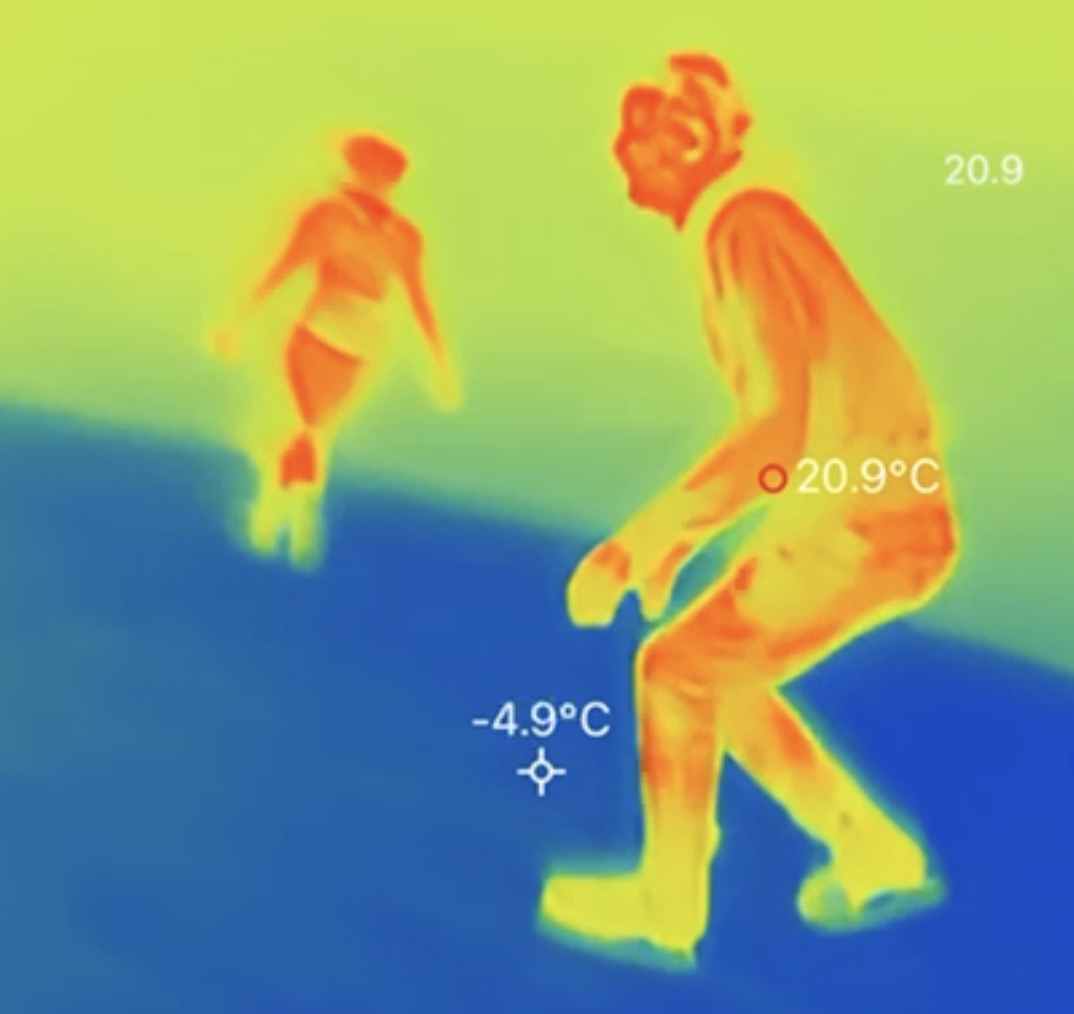
There's not a lot of pics of me skating… this one from an IR camera
I've been skating in a pair of Bauer1 Nexus N77s that I bought 7 years ago on a work trip to Toronto. These did a great job of getting me back into the hobby for 6 years but recently I felt it was time to step up to a better quality pair. Despite being a size down from my shoe size, the Nexuses are too large: I had been compensating with thick socks but still struggling to get the boots tight enough. I'd have to wear gloves to lace up because I'd cut my hands pulling the laces otherwise.
After too long researching/deliberating/kvetching (very much on trend for me) I upgraded to Bauer Vapor Fly30s another half-size down (and nearly ten times as much). The fit is much better, in almost every respect. They actually go on easier and I don't have to tear my hands tightening the laces. They feel like a natural extension of my feet. I seem to be using a different set of muscles to skate, so the first few sessions were very fatiguing, but that settled. The Vapor line is speed-oriented, which I thought would fit my skate style best.
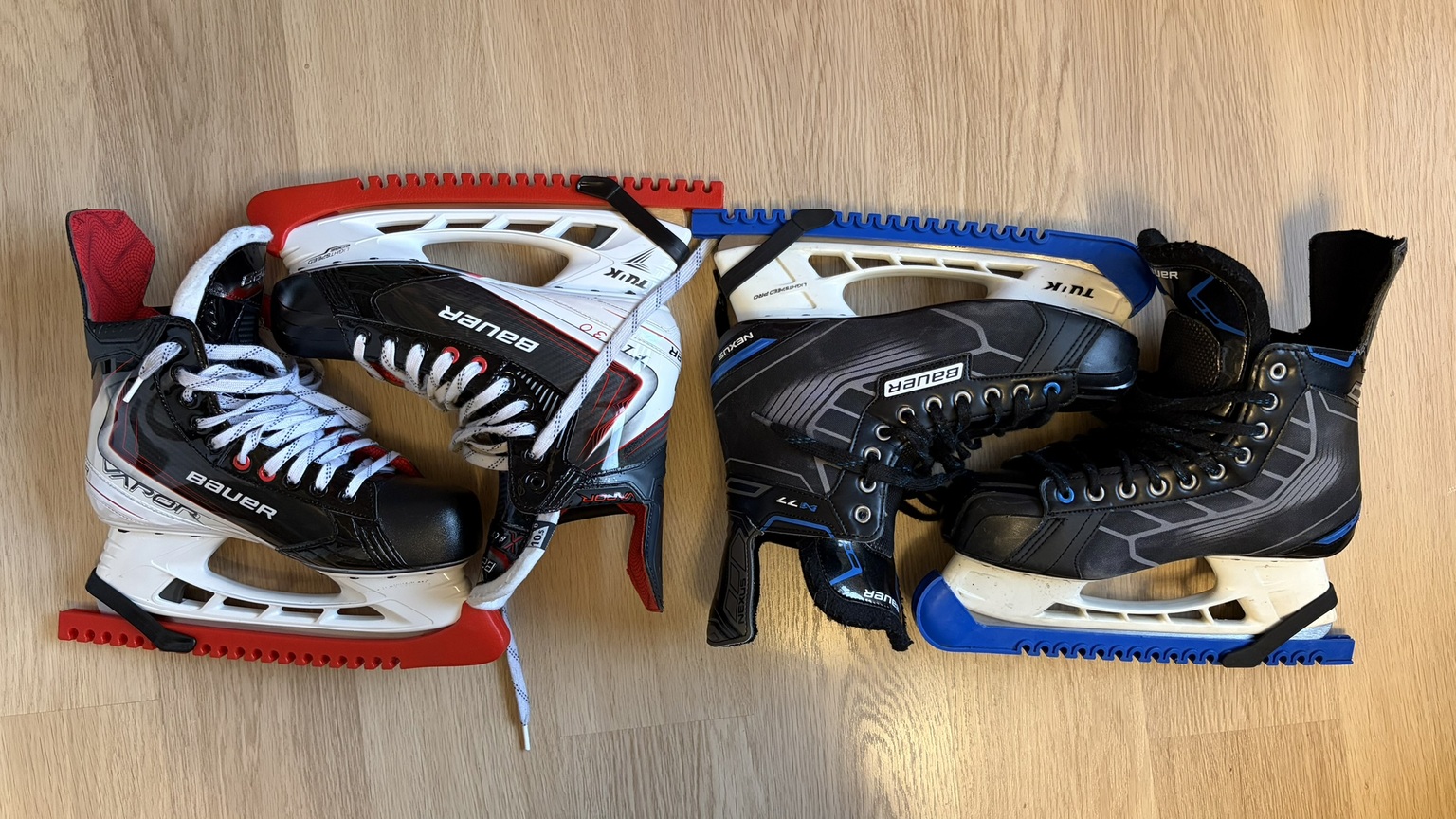
new and old skates
I have unfortunately gained a common problem: arch pain. More precisely, my navicular bone seems to be quite prominent2, and that part is pressing uncomfortably into the boot. Boots typically take a few sessions to break in, but after 7-8 sessions the pain was getting to the stage that I couldn't skate for a full session without being in agony.
The last time I skated I tried to throw everything at the problem: I'd had the skates baked3; bought some orthotic insoles; then some "Bunga" pads over the sore bit and an attempt to more loosely tie the laces over the affected area. I tried a ten minute skate, and it seemed a bit better.
I then tried experimentally to swap back to my old skates, and I felt like Bambi: I just couldn't do it! They didn't press on the navicular, and they're softer so you can compensate for the size with tight lacing, but I had no confidence in them, I couldn't lean into the turns. They just felt weird. I realised there's no way back.
I switched back to the fly30s, adjusted the bunga pad positioning, tweaked the lacing and went back on for about 40 minutes. It went well: the rink was quiet, it was cool whilst we had a heat wave outside, so I worked up a sweat. By the end there was some discomfort, but not too much, and I think partly the area is currently sensitive so just about anything will cause discomfort. Fingers (or toes) crossed that I've mitigated the problem! If not, it might be time to try a punch out.
- I've owned four pairs of skates: all hockey, my first were Bauers, my second CCM Tacks of some kind. I've no idea what happened to them.↩
- Or possibly I have accessory navicular bones↩
- modern mid-tier skates are thermoformable, and many skate shops carry a specially designed oven to briefly bake skates such that you wear them as they cool and the padding should mould to your foot.↩
Older posts are available on the all posts page.